> For the complete documentation index, see [llms.txt](https://jamonbread-io.gitbook.io/jamonbread/llms.txt). Markdown versions of documentation pages are available by appending `.md` to page URLs; this page is available as [Markdown](https://jamonbread-io.gitbook.io/jamonbread/devs/technical-and-product-requirements.md).
# Technical and product requirements
### Design
* Market with Cardano assets (NFTs)
* Offers participation on the market to 3rd parties
* Offers to use contract in own market
* There is a fixed fee of 2.5% that is distributed between all parties, that participated in successful trade
* **All datums should be compatible with original the contract designed by Vacuumlabs (verified by Cbor serialization)**
### Fees and royalty calculation
* 10% to JoB
* 20% listing marketplace
* 20% listing affiliate (can be same as a marketplace)
* 50% to selling marketplace, which can be divided into many records (affiliates)
* Royalty
**The calculation for price 100 ADA, and a typical set of treasuries and 5% royalty:**
* 92.5 ADA to the seller (100 - 2.5 (fees) - 5 (5% royalty) )
* 0.25 ADA to JoB treasury (100 \_ 0.25 \_ 0.1)
* 0.5 ADA to listing marketplace treasury(100 \_ 0.025 \_ 0.2)
* 0.5 ADA to listing affiliate treasury (100 \_ 0.025 \_ 0.2)
* 0.625 ADA to selling marketplace treasury (100 \_ 0.25 \_ 0.25)
* 0.625 ADA to selling affiliate treasury (100 \_ 0.25 \_ 0.25)
* 5 ADA to royalty treasury (100 \* 0.05)
### Tech specs
* It is not necessary to mint values
* There is an option to produce treasury during a transaction
* There is an option to consume treasury
* Logic is divided between Treasury the contract and function contracts (InstantBuy/Offer)
#### Mint
Simple contract, that checks argument OutputReference is present on inputs. The purpose is only for minting disposable assets (for treasury validation method)
#### Staking
A simple contract that is validated same as the Withdrawal method, which is passed as an argument. The second argument is just salt for PolicyId It is a stake address that can be withdrawn by the wallet/token holder
#### Treasury
Common contract where user can collect ADA value during interacting with NFT market. There are two purposes:
* Use the treasury in transaction
* Withdraw treasury
The contract holds information about the withdrawal method in datum
**Usage in transaction**
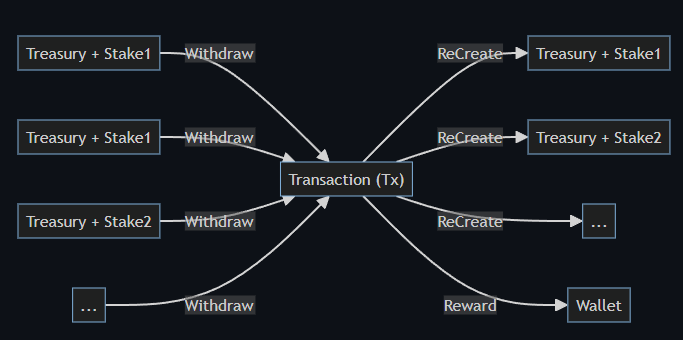
Typical usage of the treasury is, that the original UTxO is spending during the transaction and a new one is created on output. The diff between output and input is provision.
* Check, that the count of UTxOs with the same script hash and datum like spending UTxO is equal to one (there is no need to spend more than one)
* Check, that the count of UTxOs with the same address (payment credential and spending credential) is equal to One (it is not possible to burn it or change stake address)
* Check, that the output ADA on UTxO is bigger than the input ADA
* Check, that the output values of ADA are bigger than the defined minimal value
* Check, that treasury UTxOs do not contain another asset except ADA
**Usage during withdrawal**
There are two validation mechanisms, depending on the type of treasury:
* by payment credential
* by validation token
* Check, that the validation mechanism is valid
* Check that outputs UTxOs is bigger than a minimal value
* The number of the same treasury (credential, datum, stake) is present on the input and output
* The number of output treasury (credential, datum, stake) can be reduced to 5 (another can be spent without creating new ones)
#### Instant buy
Contract for buying NFTs
There are two purposes:
* Accept
* Cancel
The validator has params
```
validator(
treasury_script_hash: Hash, // Reference to treasury validator
stake_addresses: List, // List of accepted JoB stake address
job: types.WithdrawalMethod, // JoB treasury, what is present in each transaction
)
```
Information about price, royalty etc., are stored in datum
**Accept**
* Check, that the ADA sent to a user is correct
* Check, that all provisions are correct
* Check, that the basis of royalty is not lower than the minimal value
* Check, that portions defined in the redeemer are correct
* If the royalty (payment credential) is the same as the seller's address, the royalty is not paid to a treasury, but directly to the seller's address
**Cancel**
The transaction is signed by stored payment credentials There is no other check for the spending contract
#### Offer
Is very similar to instant buying instead of a final check to pay assets/ADA to the offerer's address.
Information about price, royalty etc., are stored in datum